Annual Reports
Sonova Holding AG's annual reports contain management's most considered account of the business. These are the sections, passages and visual pages worth opening in the originals preserved in Sources.
Sonova Holding AG — 2025/26 Annual Report (FY ended 31 March 2026) — FY2025/26
The latest report, written into a strategy reset: new leadership relaunches the strategy, sets a CHF 6bn-by-2030/31 goal, and divests Consumer Hearing. · Open the full document →
Letter to Shareholders — p. 4 · Read the full section →
Management's considered framing of the new chapter — the ambition, the transformation, and how the year's numbers support it.
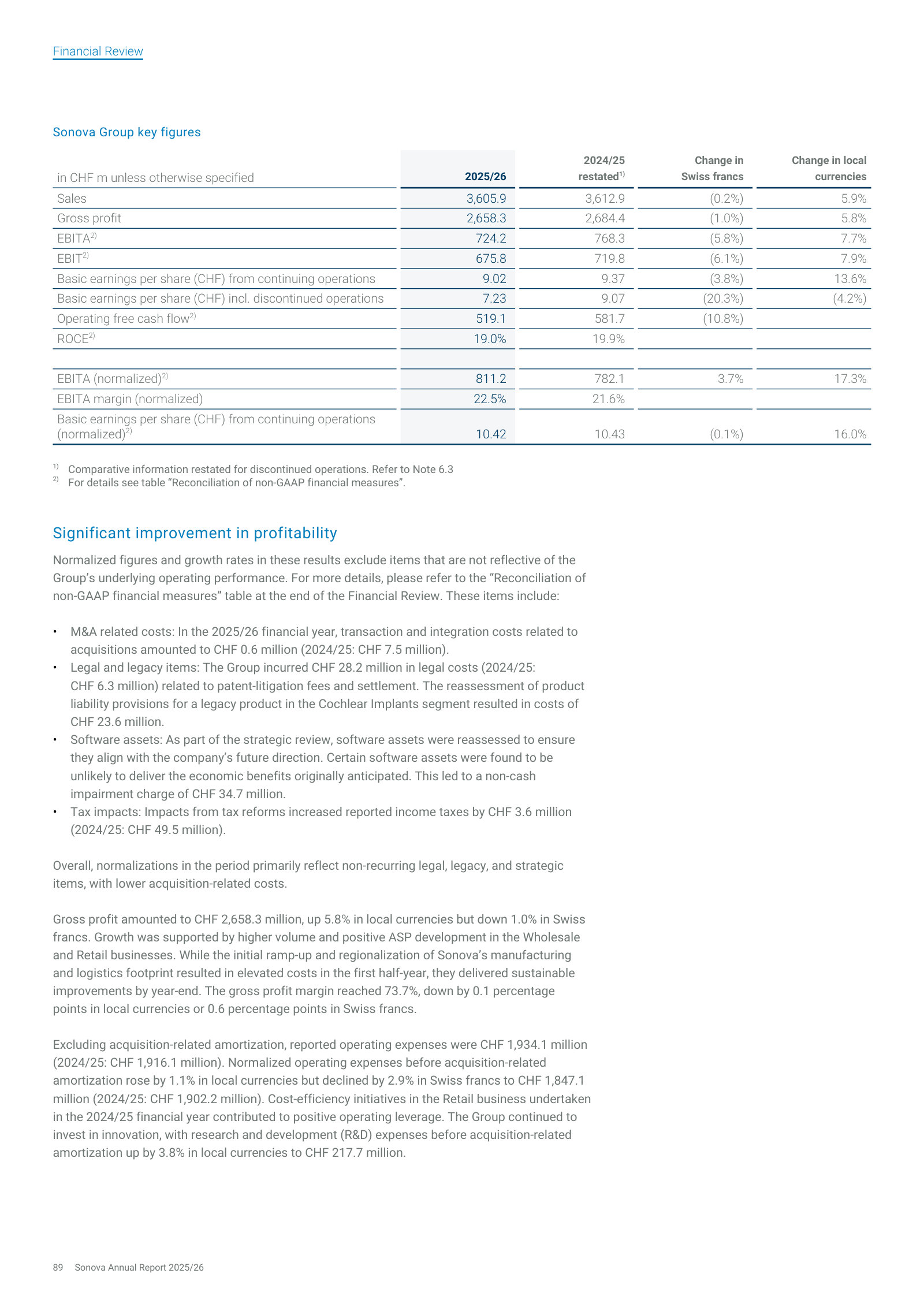
New leadership's ambition: 5.9% local-currency growth, +17.3% normalized EBITA, and a CHF 6bn revenue target by 2030/31.
In the 2025/26 financial year, Sonova delivered sustained market share gains and meaningful operating leverage, reaffirming the strength of our business and illustrating that value-creating transformation and execution can go hand in hand. We achieved robust sales growth of 5.9% and a 17.3% increase in normalized EBITA, in local currencies and from continued operations. […] Our ambition is clear: to reach CHF 6 billion in revenue by 2030/2031, improve the lives of 30 million people, and strengthen our position at the intersection of medtech, technology, and lifestyle.
p. 5 · Read in context →
Our renewed strategy and ambition — p. 10 · Read the full section →
The March-2026 strategy reset and the market thesis behind it — the three priorities the rest of the report is organized around.
Low hearing-aid adoption is the structural tailwind; the reset rests on three priorities: innovate, succeed locally, excel in operations.
The world hearing care market shows clear signs of structural growth and Sonova is very well positioned to capture this opportunity. Demand is expected to continue expanding, driven by aging populations and longer treatment horizons. While the prevalence of hearing loss remains stable, persistently low adoption rates create significant headroom for growth across all regions – particularly in Asia. […] It is built around three strategic priorities: innovate for adoption, succeed locally with a multi-channel, multi-brand approach, and excel in operations for growth.
p. 10 · Read in context →
Financial Review — p. 88 · Read the full section →
The MD&A, and where management discloses the year's biggest structural change: divesting Consumer Hearing and renaming the segments.
23 March 2026: Consumer Hearing to be divested (now discontinued ops); Hearing Instruments recast as Wholesale plus Retail.
On 23 March 2026, Sonova announced that, following a strategic portfolio review, Sonova intends to divest its Consumer Hearing business. As a result, the business is classified as discontinued operations, and the relevant comparative figures for the 2024/25 financial year have been restated accordingly. Figures and growth rates refer to continuing operations and exclude the Consumer Hearing business, unless otherwise stated. In addition, the Hearing Instruments business will be referred to as the Wholesale business, and the Audiological Care business as the Retail business, from this point forward.
p. 89 · Read in context →
Hearing Instruments segment – Strong sales growth — p. 91 · Read the full section →
The core engine (93% of sales): Wholesale accelerated on new product launches while Retail grew on reinvested cost savings.
Wholesale +9.5% on Infinio Ultra and Virto R Infinio; Retail +5.1% as cost savings fund lead generation.
Sales in the Hearing Instruments segment totaled CHF 3,353.8 million, reflecting an increase of 7.5% in local currencies and 1.4% in Swiss francs. Organic sales growth was 6.9%, while acquisitions contributed an additional 0.6% equating to CHF 18.7 million.
Sales in the Wholesale business reached CHF 1,861.8 million, up 9.5% in local currencies. Growth was driven by strong market reception of Infinio Ultra, which built on the success of the Infinio and Infinio Sphere™ platforms, and of Virto R Infinio. As a result, the business significantly expanded its market share globally and achieved double-digit growth in the second half-year, on a much higher comparison base from the prior-year period, reflecting the strong momentum.
The Retail business reported sales of CHF 1,491.9 million, representing an increase of 5.1% in local currencies. Organic growth reached 3.8%. Reinvesting a portion of cost savings from measures implemented in the 2024/25 financial year into targeted lead-generation initiatives contributed to above-market growth. Acquisitions lifted sales by 1.3% (including the full-year effect of prior year acquisitions), mainly in Germany, Australia, and Canada.
p. 91 · Read in context →
Cochlear Implants segment – Continued headwinds — p. 92 · Read the full section →
The company-specific soft spot: China volume-based procurement and a competitor's launch drove a double-digit decline.
Cochlear Implants −11.1% in local currency on China VBP and a top competitor's launch; ex-China systems roughly flat.
Sales in the Cochlear Implants segment totaled CHF 252.1 million, a decline of 11.1% in local currencies and 17.1% in Swiss francs. System sales were down 10.3% in local currencies. The business in China was substantially hampered by challenges following the introduction of volumebased procurement (VBP). Developed markets saw increased competitive pressure following a product launch by the largest competitor in the second half-year. Excluding China, system sales were up 0.7% in local currencies. Sales of upgrades and accessories were down by 13.1% in local currencies, as many recipients have already adopted the Marvel sound processor technology introduced in 2021.
p. 92 · Read in context →
Five Year Key Figures — p. 96 · Read the full section →
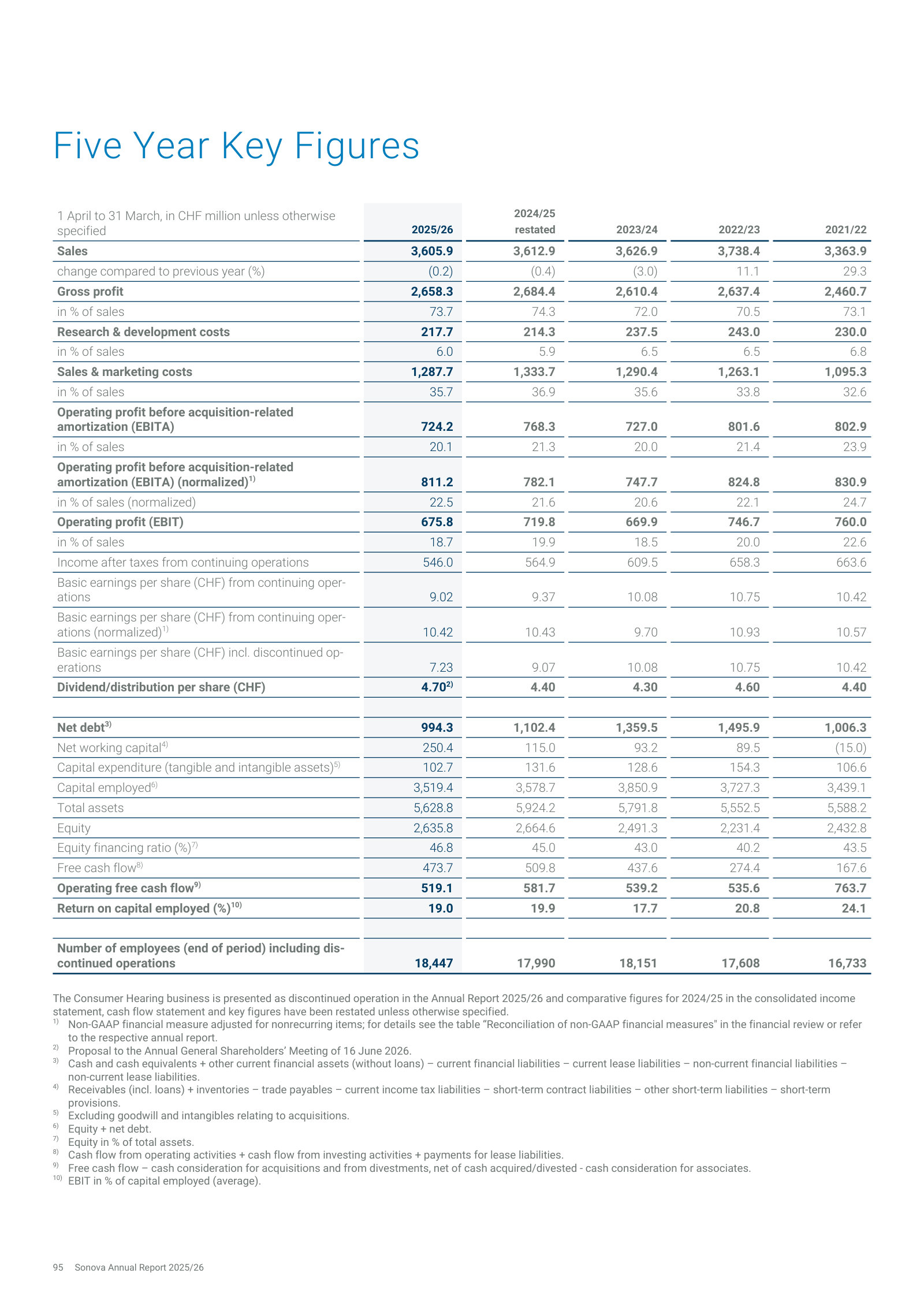
One page of five-year trend for sanity-checking the story: sales, margins, EPS, dividend, net debt and returns.
Key audit matters — p. 167 · Read the full section →
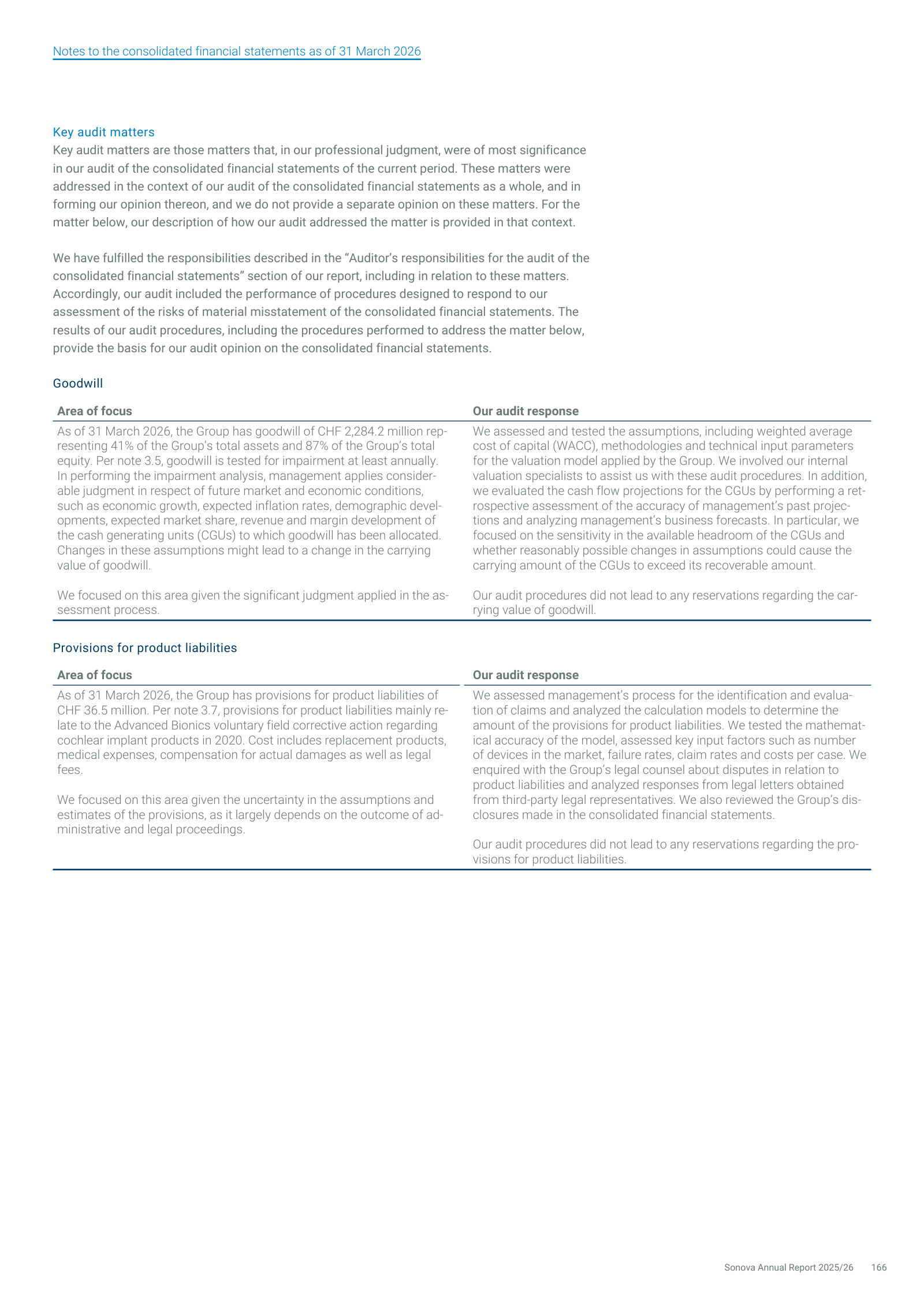
What the auditor singled out as the real estimation risks — goodwill and the Advanced Bionics product-liability provision.
Goodwill of CHF 2,284.2m is 41% of assets and 87% of equity — its carrying value rides on management's growth and margin assumptions.
As of 31 March 2026, the Group has goodwill of CHF 2,284.2 million representing 41% of the Group’s total assets and 87% of the Group’s total equity. Per note 3.5, goodwill is tested for impairment at least annually. In performing the impairment analysis, management applies considerable judgment in respect of future market and economic conditions, such as economic growth, expected inflation rates, demographic developments, expected market share, revenue and margin development of the cash generating units (CGUs) to which goodwill has been allocated. Changes in these assumptions might lead to a change in the carrying value of goodwill.
p. 167 · Read in context →
Double materiality assessment — p. 189 · Read the full section →
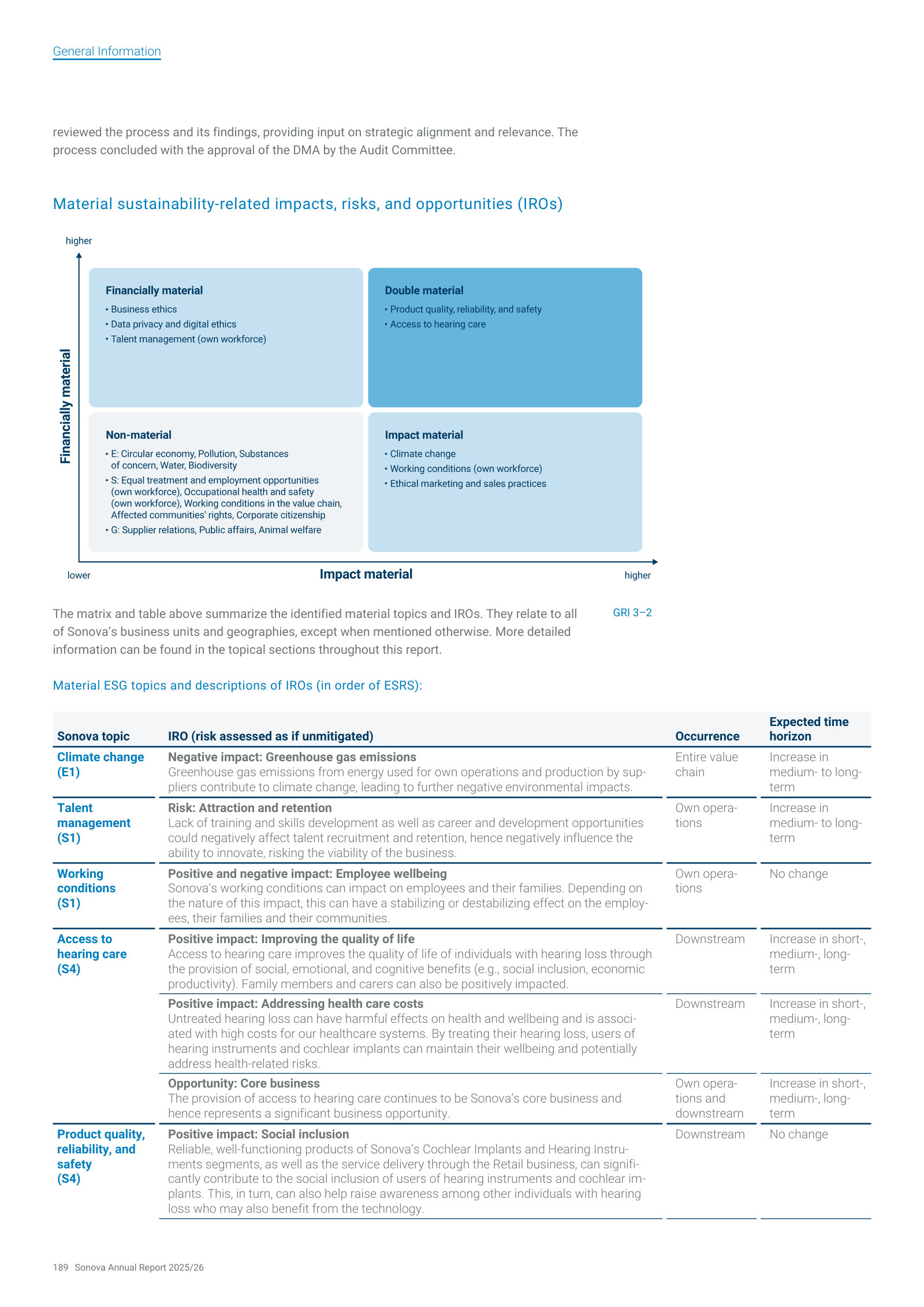
Sonova's own mapped risk landscape — the closest thing a Swiss report has to risk factors.
More annual reports
Sonova Holding AG — 2024/25 Annual Report (FY ended 31 March 2025) — FY2024/25 · 278 pages · The prior year under the old structure (Consumer Hearing still continuing) — the baseline the 2025/26 restatement revises. · Open →
Sonova Holding AG — 2023/24 Annual Report (FY ended 31 March 2024) — FY2023/24 · 288 pages · Where the Retail cost-efficiency program and the last full double materiality assessment were set in motion. · Open →
Sonova Holding AG — 2022/23 Annual Report (FY ended 31 March 2023) — FY2022/23 · 305 pages · Peak-margin year (normalized EBITA 22.1%) before the FX and Cochlear-Implants China headwinds set in. · Open →
Sonova Holding AG — 2021/22 Financial Report (FY ended 31 March 2022) — FY2021/22 · 287 pages · The post-pandemic recovery year, +29% sales — a useful low base for the current cycle. · Open →